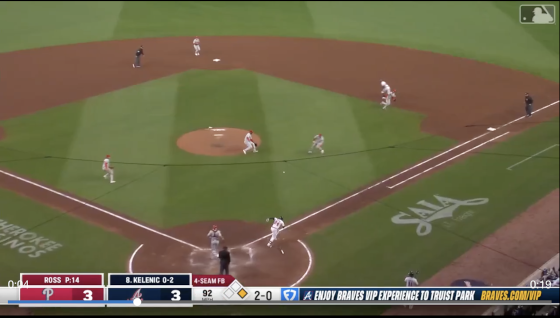
Atlanta's Jarred Kelenic sprints to first, having bunted a foul ball, upon which the pitcher and first basemen of the Philadelphia Phillies are converging. Another runner is headed from first to second. Click here to see this play, which we reccomend as the camera angle shown here gives you a good idea of how the various defenders involved anticipate/react to the bunted ball.
Bunt into a Fielder's Choice
When there are runners on, and the batter bunts, the fielder who comes up with the ball will have a choice. Often times, that fielder will get the ball and throw it so quickly that it doesn’t seem like they’re making a choice; it's more an automatic action that comes from hundreds upon hundreds of hours of practice. But they are still making a choice, and that choice depends greatly on the state of the game, how many outs there are to begin with, and who is running. Just like the offense might attempt a sacrifice bunt in the hopes of scoring a single run, the defense may be just as invested in preventing that run from scoring. So, the defense may go after the lead runner, or go for the play at the plate, allowing the batter to take first. In this case, the batter is not credited with a base hit, instead they take first on the fielder’s choice. The defense, meanwhile, hopes that the choice pays off with at least one out on the bases... if not more1.